01
Tezhip
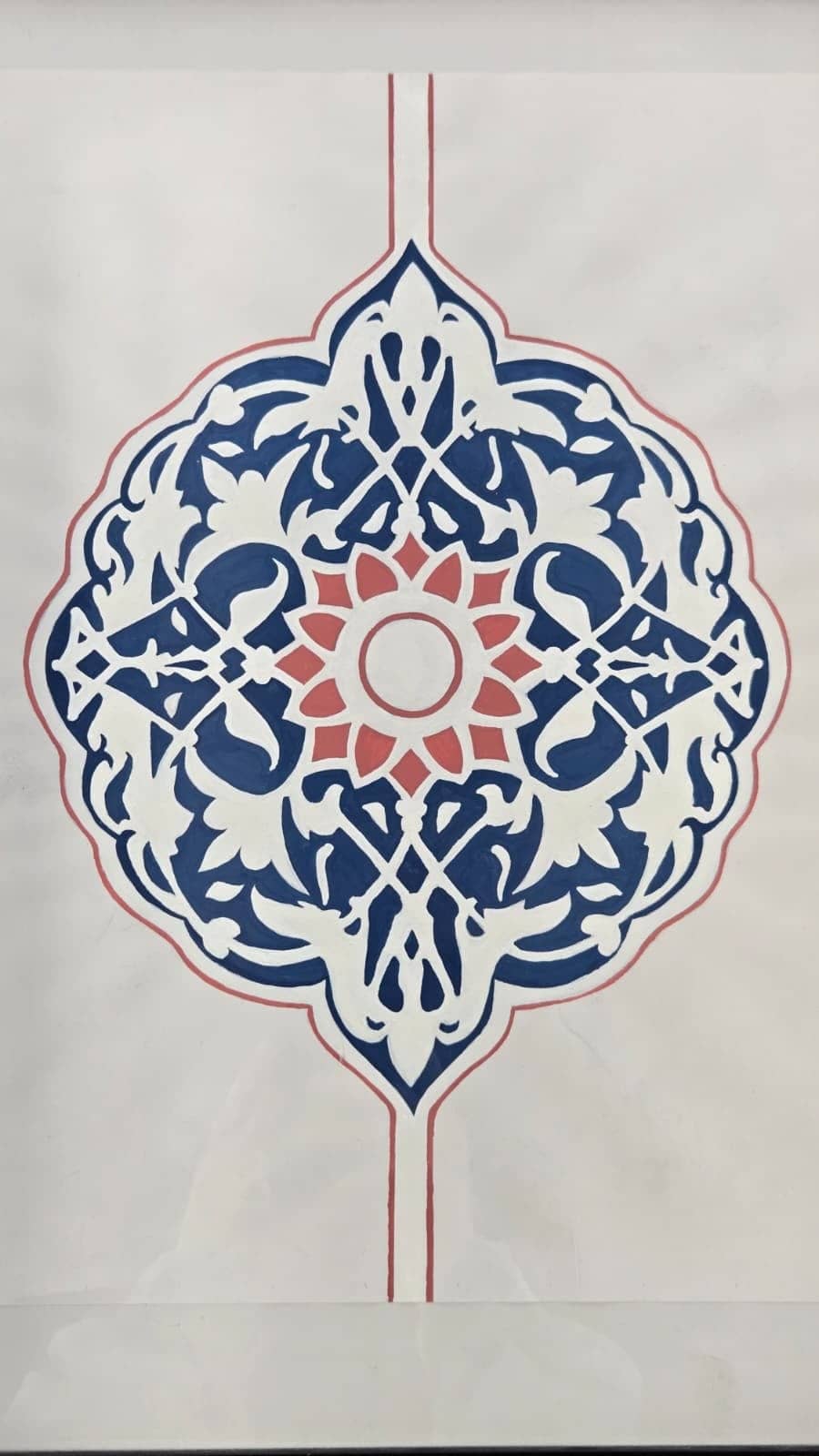
Manuscript illumination: and motifs in pigment and gold, framed by borders and opened by a at the center.
The practice
On illumination and the hatayi motif
Detail, Hatayi rosette
comes from the Arabic root zeheb, gold. In practice the word means to ornament, to gild, to lighten a page: gold laid over pigment so that a sacred text is framed by something that catches light. The forms it uses are ornamental rather than figurative. Five-petal florals called , leaves, buds, and the compound blossom known as the .
Hatayi motifs were refined through the Ottoman period in the fifteenth and sixteenth centuries, though their origins run much further back, to the Timurid workshops of Herat and Tabriz, and earlier still to Persia and China. Each shape has a name, an era, and a lineage of hands that changed it.
What draws me to it is proportion. I am pulled toward flowers the way a bee is, I photograph them constantly, and the more closely I look, the more the same ratios keep surfacing: in a blossom, in a shell, in the arm of a galaxy. The golden ratio is not a decoration laid over nature; it is how nature is put together. The traditional compositions know this. They are built on the same correspondence.
So the work moves between two poles that turn out to be one: the floral vocabulary of illumination, and the that holds it in place.
Manuscript illumination: and motifs in pigment and gold, framed by borders and opened by a at the center.
Arabic calligraphy with reed and brush, studied through a weekly cohort. The letter is drawn first; the illumination answers it.
Compass-and-rule constructions, drawn to sit under the floral work. Every rosette begins as a circle divided.
Lineage
The motifs on these pages did not begin in Istanbul, and they did not end there. A short history of the road they took.
Early Persia · 9th to 12th c.
Baghdad, Shiraz, Isfahan
The earliest illumination appears around copies of the Qur'an, where gold and pigment frame the sacred text rather than illustrate it. Frontispieces are built from pure geometry, circles and stars laid out with compass and rule. The script is kufic, angular and monumental. Here the basic vocabulary is set: gold on paper, ornament in service of the word, pattern built from measured proportion rather than drawn freehand.
Seljuk · 11th to 13th c.
Konya, Anatolia
As Seljuk rule reaches Anatolia, the same geometry and the rumi split-leaf motif travel with it, carried in books and in the hands of craftsmen. Here the patterns leave the page. Stone portals, carved wood minbars and glazed tile all carry the same interlace, the same split leaf turning back on itself. The land itself takes the name Rûm, the Roman lands, and the region's later style keeps that word.
Timurid · 14th to 15th c.
Herat, Tabriz, Samarkand
Trade routes east bring Chinese lotus and peony forms into the Timurid courts, where they are reworked into the hatayi, a compound blossom shown in cross-section. The royal book workshop, the kitabhane, gathers calligraphers, painters and illuminators under one roof to produce a single manuscript together. Here illumination reaches a particularly refined balance of gold, lapis and floral pigment, a standard later workshops keep returning to.
Ottoman · 15th to 19th c.
Istanbul
In Istanbul the palace workshop, the nakkaşhane, brings hatayi, rumi and geometry together into a settled classical style. In the sixteenth century the court illuminator Kara Memi adds naturalistic flowers, tulip, carnation and rose, drawn from observation rather than convention, and the vocabulary widens. The same forms spread across mediums: İznik tile on mosque walls, gold leaf on manuscript pages, paint under a dome.
Revival · 20th c.
Istanbul
By the twentieth century the manuscript age has ended, and illumination has no obvious place left to live. It survives instead through a small number of masters of the early Republic, who take on students directly and pass the craft on hand to hand rather than through institutions. The format changes with it. Illumination moves off the book page and onto the framed panel, made to be hung rather than bound and read.
Now · 2026
Greenville, South Carolina
The same motifs are drawn today on paper in the American South: hatayi and penç laid out in gold and pigment, geometry ruled underneath in compass lines. Teaching still passes from person to person, now across distance rather than inside one studio. In Greenville, South Carolina, most people meeting this work encounter it for the first time, an old tradition practiced in an unfamiliar place, still made by hand, one petal at a time.
01 · Early Persia
9th to 12th c. · Baghdad, Shiraz, Isfahan
The earliest illumination appears around copies of the Qur'an, where gold and pigment frame the sacred text rather than illustrate it. Frontispieces are built from pure geometry, circles and stars laid out with compass and rule. The script is kufic, angular and monumental. Here the basic vocabulary is set: gold on paper, ornament in service of the word, pattern built from measured proportion rather than drawn freehand.
02 · Seljuk
11th to 13th c. · Konya, Anatolia
As Seljuk rule reaches Anatolia, the same geometry and the rumi split-leaf motif travel with it, carried in books and in the hands of craftsmen. Here the patterns leave the page. Stone portals, carved wood minbars and glazed tile all carry the same interlace, the same split leaf turning back on itself. The land itself takes the name Rûm, the Roman lands, and the region's later style keeps that word.
03 · Timurid
14th to 15th c. · Herat, Tabriz, Samarkand
Trade routes east bring Chinese lotus and peony forms into the Timurid courts, where they are reworked into the hatayi, a compound blossom shown in cross-section. The royal book workshop, the kitabhane, gathers calligraphers, painters and illuminators under one roof to produce a single manuscript together. Here illumination reaches a particularly refined balance of gold, lapis and floral pigment, a standard later workshops keep returning to.
04 · Ottoman
15th to 19th c. · Istanbul
In Istanbul the palace workshop, the nakkaşhane, brings hatayi, rumi and geometry together into a settled classical style. In the sixteenth century the court illuminator Kara Memi adds naturalistic flowers, tulip, carnation and rose, drawn from observation rather than convention, and the vocabulary widens. The same forms spread across mediums: İznik tile on mosque walls, gold leaf on manuscript pages, paint under a dome.
05 · Revival
20th c. · Istanbul
By the twentieth century the manuscript age has ended, and illumination has no obvious place left to live. It survives instead through a small number of masters of the early Republic, who take on students directly and pass the craft on hand to hand rather than through institutions. The format changes with it. Illumination moves off the book page and onto the framed panel, made to be hung rather than bound and read.
06 · Now
2026 · Greenville, South Carolina
The same motifs are drawn today on paper in the American South: hatayi and penç laid out in gold and pigment, geometry ruled underneath in compass lines. Teaching still passes from person to person, now across distance rather than inside one studio. In Greenville, South Carolina, most people meeting this work encounter it for the first time, an old tradition practiced in an unfamiliar place, still made by hand, one petal at a time.
Where it comes from
Turkish art is rich in forms most people in the American South have never encountered: İznik ceramics, water marbling, architecture of extraordinary density, and manuscript illumination. All of it is the imprint of an empire that reached across regions, and all of it was left on walls, paper and pottery.
My reference is childhood: the mosques of Istanbul and Bursa in summer, Rüstem Paşa, Çamlıca, the Grand Mosque of Bursa, where tilework, lettering, and the call to prayer five times a day arrived as one impression rather than three. The current work returns there: my own photographs of those interiors, the calligraphy particular to each, the illumination that opens across a dome.
Glossary
The words used across this site, with the script they came from.
تذهيب
from Arabic zeheb (dhahab), gold
Manuscript illumination: gold and pigment ornament framing a text. The word also names the wider Ottoman decorative art built from that ornament, applied to book pages, panels and bindings alike.
ختايى
"of Cathay," Chinese-derived
A stylized compound blossom shown in cross-section, developed from Chinese lotus and peony forms as they passed through Timurid Herat and Tabriz. It is the core floral vocabulary of Ottoman illumination, the shape most other motifs are drawn around.
پنج
Persian panj, five
A five-petaled flower seen from above, the simplest floral unit in the vocabulary. It often sits at the center of a composition, with hatayi and rumi forms built out around it.
شمسه
from Arabic shams, sun
The sun-form medallion at the center of a book cover or opening page, usually lobed. It is often finished with tığ finials above and below, pointing the composition outward along a single axis.
رومى
"of Rûm," the Seljuk lands of Anatolia
The split-leaf scrolling motif, abstracted from animal forms, that interlaces through and around floral work. Its origin is often traced to Central Asian animal art carried west into Seljuk Anatolia, then folded into the Ottoman decorative language.
تيغ
needle, crochet hook
The slender pointed finials that grow outward from the edges of a headpiece or medallion into the empty margin. They carry the eye past the filled composition and give it a direction of travel.
حسن خط
"beautiful writing"
Islamic calligraphy as practiced in the Ottoman tradition, written with a reed pen (kalem) in scripts such as thuluth, naskh and ta'liq. Havva's own practice draws on this tradition using brush and reed together.
ابرو
Persian abru, cloud, or ab-ru, water-face
Paper marbling: pigments floated on a thickened bath and combed into patterns, then lifted onto paper. It developed as a companion art to illumination, often used as a ground for a calligraphy panel or a book cover.
هندسة
compass and straightedge
Interlaced star-and-polygon patterns constructed from circle grids. This geometry is the framework under floral work in tile, wood and paper, setting the proportions that the hatayi and penç motifs then fill.
زنجيرك
little chain
The narrow interlaced chain border that frames an illuminated page, running along all four edges. It marks the edge of the composition, holding the floral and geometric work inside a fixed boundary.
حلكار
"gold work"
Illumination drawn in diluted gold alone, shaded in gold, without solid pigment. It is quieter than full-color tezhip and is often used for margins and the spaces around a main composition.